2008 Season
It's Sunday, and It's Still Yarmouth Port!
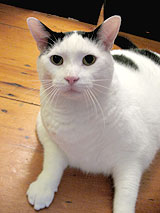
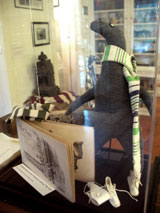
Ombledroom inspects all visitors
Online bidders prevail!
Images in the middle, from top to bottom:
EGH Chairman Tom Michalak opens the live auction
Mystery! poster donated by Ed Bradford on the block
Lé Théâtricule Stoïque performs The Curious Sofa
For more information call the Edward Gorey House
(508) 362-3909
Images by Glen Emil.
HAVING JUST toured the Edward Gorey House, I want to tell you everything, and not spoil anything. Not that I really could. The nature of Gorey's work doesn't allow it to be just given away like a plot. I think his work is more experiential. Even though it lives on paper like normal books, Edward Gorey's art and letters are anything but normal. It occurred to me after I went to the local bookstore and found, sitting by itself, a brand new Eclectic Abecedarium, as published by Pomegranate. No other titles to keep it company, no Amphigoreys or Insect Gods to keep it from getting lost or overlooked, but just little old Eclectic Abecedarium. Just like its readers, this little book was keeping to itself, in the corner of the shelf, trying not to be noticed. But there's something about a little book that tries hard not to be noticed - it gets noticed. This version of the tiny 1 5/16-inch classic stood out for all its diminutive charm.

Truth be told, this little reprint stood out for me because the familiar cover illustration was colored! I wasn't prepared for it. And it stirred a youthful voice in me. 'Is this cute or what!' I found myself thinking, and picked it from the shelf. The book was sealed in plastic, but I didn't mind, I bought it anyway. It intrigued me into making the purchase, just as a good book cover should. And though it's 'just a reprint', it's a lot of fun. I'm glad I got it.
After appreciating the colorful handiwork, I remembered how Mr Motoyuki Shibata, in his translation notes at the end of the Japanese release of Eclectic Abecedarium, encourages the reader to experiment, and to try and adapt their own verses and even color the tiny illustrations for fun. How right he was! I want to pick up a non-colored version and start on my own interpretation right away.
 . . .
. . .
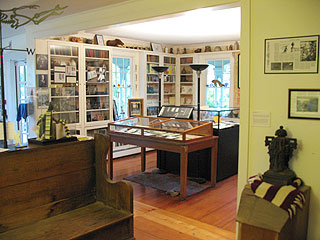
Rick Jones graciously allowed me to peruse the Edward Gorey House's 2008 exhibits while he and Duncan Gibson, the assistant curator, put away all the GoreyFest auction props and tables from the previous night. The auction was a success, again, and they were rightfully exhausted. I didn't want to interrupt with questions, so poked quietly, and happily from case to case. There was much to be absorbed, and I knew it couldn't all be done in the two hours I had before departing for Boston's Logan airport to make my flight. It would take 1 1/2 hours to drive, but it had been raining and the potential for delay was ripe. Even so, one cannot rush Gorey.
Starting from the farthest room in the rear, I came up to the Mystery! Theatre room. Fortunately, the exhibit remained mostly intact from a few years previous. Apparently WGBH donated some of the props used on the set while Diana Rigg was host of the program. The sets were marked with tags belonging to the Mystery! II series. I wondered what happened to Mystery I, I thought. I was very relieved to see a case with a few of the animation cels created for the opening sequences by Mr Derek Lamb. They were left over from the previous exhibit, which I missed. Animation art is of particular interest for me as well, and I studied them closely. Gorey had provided three or four characters drawings for the key animators, the people who create the sketches that are eventually turned into the hand painted figures on acetate plastic sheets, or animation cels. They are then photographed, in sequence over painted backgrounds. Make several hundred of these, and you have thirty seconds of animation. I was ecstatic.
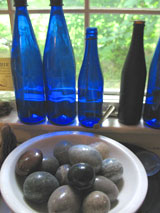
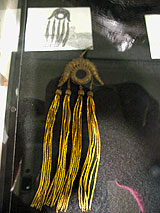
An adjoining case held a variety of old tassels. They turned out to be models for those ominous objects menacing various innocents in Les Passementaries Horribles [1976]. There were a half dozen matching original art pieces used for the book. Very nice. True to the house's previous owner, every corner is crammed with stuff. Bowls of rocks and glass balls. Blue bottles in the windows. The kitchen is restaged to resemble its appearance eight years past, using Kevin McDermott's Elephant House photos from the time period. The most amusing, I thought, were the props lying around the kitchen, hallway and staircases. Some of them were just there for the post-auction cleanups, others, like the frames, were intentionally placed. How wonderfully self-indulgent!
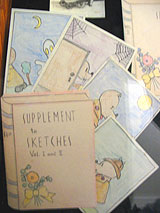
The wood and glass case containing this year's feature exhibit is located in the middle of the main floor, between the front room and center space. It's surprisingly small, compared to the other exhibits. But the contents say a lot about recognizing talent at a young age. Within were a few examples, there must have been many more, of colored drawings from Edward Gorey's learning years. There were several series of feline and canine character drawings from 1937 [that makes him 12 years old] which charmingly depict some of the popular dances and dance floor shimmies of the Jazz Era: the 'Susie Q', 'Peckin', and the 'Covina Roll' [taken from a popular movie musical Harold Teen (1934), based on the 1920's comic strip by the same name drawn by Card Ed [pronounced 'eed']. The movie takes place in Covina - not West Covina, California, 22 miles from Los Angeles. I've been there. It's a nice place.].
There were many, many smaller exhibits designed to reveal the evolution of Gorey's illustrations for many popular titles, including Categor y, The Doubtful Guest, Cautionary Tales for Children, The Jumblies, Miss Clawfooty and the Demon, and an unpublished Dracula title. The gift shop had grown in size, to accommodate a much larger selection of Gorey stuff. As predicted, I ran out of time. An entire room remained unexplored. That's fine. It will give me a reason to come back, sooner this time.
The Edward Gorey House is lovingly maintained and curated by Rick Jones and Duncan Gibson and a crew of volunteer creatives (is there any other kind?), staffed by a troupe of docents who were, ten year ago, neighbors and friends of Mr Gorey. They can tell you things books yearn to tell. All these things rolled up into one place, to bring all that Gorey lived and breathed, and be presented with the unprocessed feel of a working studio, all the while keeping the presence of a kindly yet confident man, a product of another era; the talented, self-studied and iconic personality that is Gorey.
Glen Emil,
Goreyography
Oct 5, 2008
Special thanks to Rick Jones, Duncan Gibson, and Tom Michalak for their kind assistance.
©2008 Goreyography+WZP. All rights reserved.
xxx
xxx
xxx
xxx